Day Trips from Split
From Split you can reach UNESCO World Heritage Sites, two extraordinary national parks, ancient Roman cities and one of the world's most beautiful medieval walled cities — all within a half-day's travel.
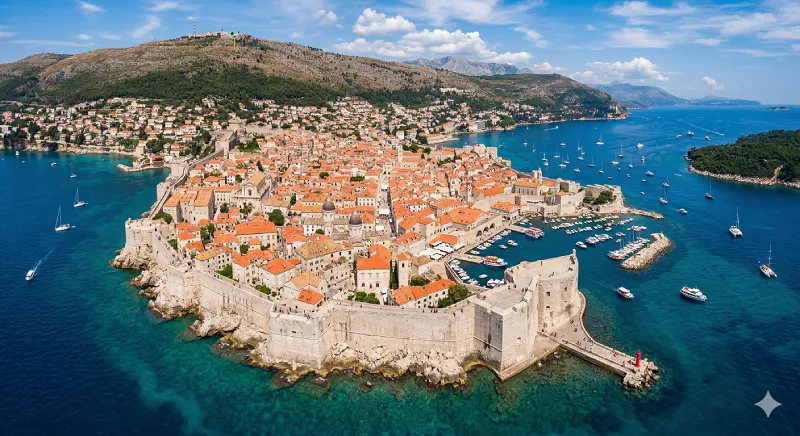
Dubrovnik
Dubrovnik — the Pearl of the Adriatic — is one of the most perfectly preserved medieval walled cities in the world. Founded in the 7th century, the city grew into a powerful maritime republic that rivalled Venice for centuries. The old town, entirely enclosed within 2km of Renaissance walls, is a labyrinth of marble streets, baroque churches and hidden squares. Walk the full circuit of the city walls for breathtaking views over the terracotta rooftops and the Adriatic beyond. Within the walls, explore the Rector's Palace, the Franciscan monastery (home to Europe's oldest pharmacy), and Stradun — the gleaming main promenade. Cable car to Mount Srđ for a panoramic view of the whole region.
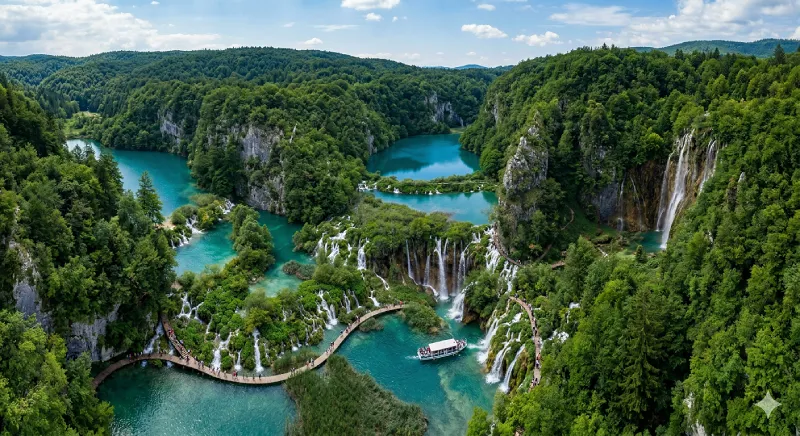
Plitvice Lakes NP
Plitvice Lakes National Park is Croatia's most visited attraction — and with good reason. Sixteen terraced lakes, cascading into each other through a series of waterfalls, set within ancient forest. The water is a remarkable shade of turquoise and emerald green, coloured by dissolved minerals and algae. The park has 18 km of wooden boardwalk trails winding around and across the lakes, with electric boat and train connections between the upper and lower sections. The famous Veliki Slap — the tallest waterfall in Croatia at 78 metres — is the centrepiece. The park is beautiful in every season — summer for green lushness, autumn for golden forest colours, winter for ice formations.
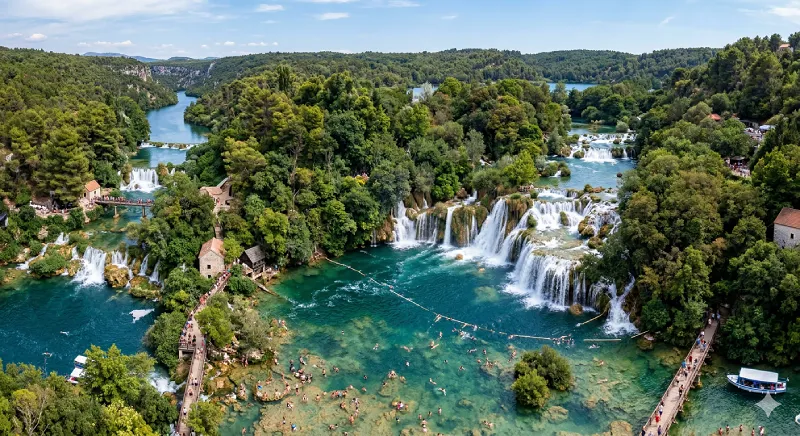
Krka National Park
Krka National Park is named after the Krka river, which tumbles through a series of extraordinary travertine waterfalls before reaching the sea at Šibenik. The star attraction is Skradinski Buk — a cascade of 17 stepped waterfalls that visitors can swim beneath (note: swimming has been restricted in recent years — check current regulations). The medieval island monastery of Visovac sits in the middle of the river and can be visited by boat. The park is significantly closer and more easily accessible from Split than Plitvice, making it an excellent half-day option.
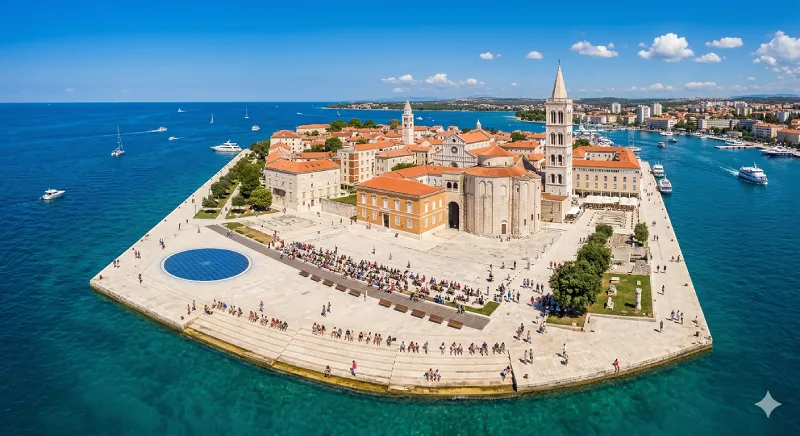
Zadar
Zadar is one of the oldest continuously inhabited cities in Croatia, with a history stretching back 3,000 years. Its compact old town occupies a long peninsula and contains an extraordinary concentration of history: a 1st-century Roman forum (one of the largest in the eastern Adriatic), early Christian and medieval churches, Venetian city walls, and two unique modern installations. The Sea Organ (Morske orgulje) is an architectural masterpiece — 35 organ pipes built into the seafront steps, powered by waves and wind to produce ever-changing musical harmonies. Just metres away, the Sun Salutation (Pozdrav Suncu) is a 22-metre solar-powered light installation that creates spectacular patterns at night. Alfred Hitchcock, visiting in 1964, described the sunset from Zadar as "the most beautiful in the world."
Omiš & Cetina Canyon
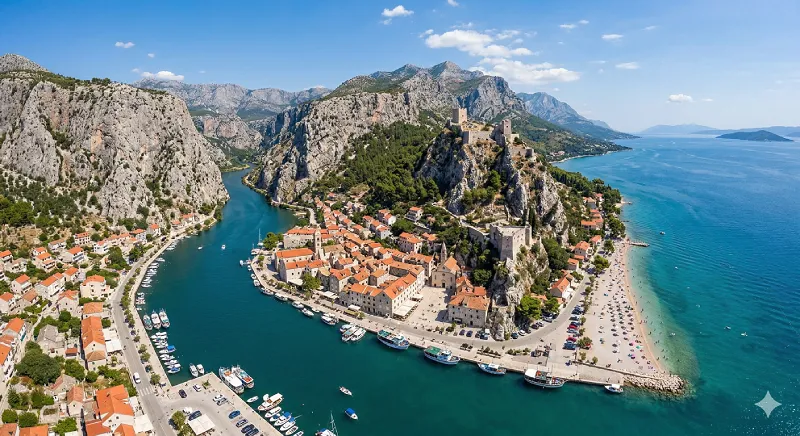
Omiš is the closest day trip destination from Split and one of the most dramatic — a compact fortified town squeezed between the mouth of the Cetina river and towering limestone cliffs. Founded as a pirates' stronghold in the medieval period (the Omiš pirates were feared across the Adriatic), the town retains two hilltop fortresses commanding the canyon entrance. The Cetina canyon itself is the playground — raft the river through sheer limestone walls, zip-line across the gorge at 120m height, cliff-jump into the Cetina pools, or simply hike the canyon trail to the freshwater spring at Cetina village. A perfect action-packed day out.
Velebit & Paklenica NP
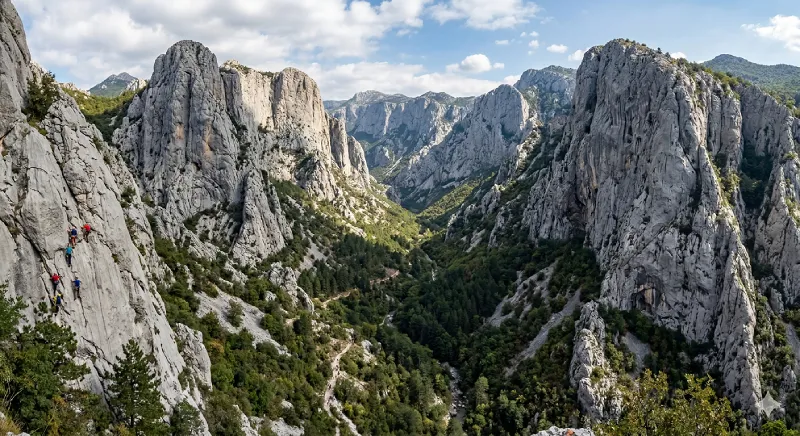
Velebit is Croatia's largest mountain range — a 145 km limestone massif rising from the coast to over 1,700m, designated both a UNESCO Biosphere Reserve and a national park. Paklenica National Park, at the southern end of Velebit, contains two dramatic canyons — Velika Paklenica and Mala Paklenica — cut into sheer white limestone walls. The main canyon trail is one of Croatia's most popular hikes, with a series of progressively more remote huts deeper into the mountains. For climbers, Paklenica's Anić Kuk rock face (350m) is legendary. The Velebit interior is also home to brown bears, wolves and chamois.